By Azabache Producciones on
A 50/50 perforation ratio does not certify visibility: what vehicle windows require
Film, glass and placement determine actual visibility. Learn what to request before printing and installation in Medellín.
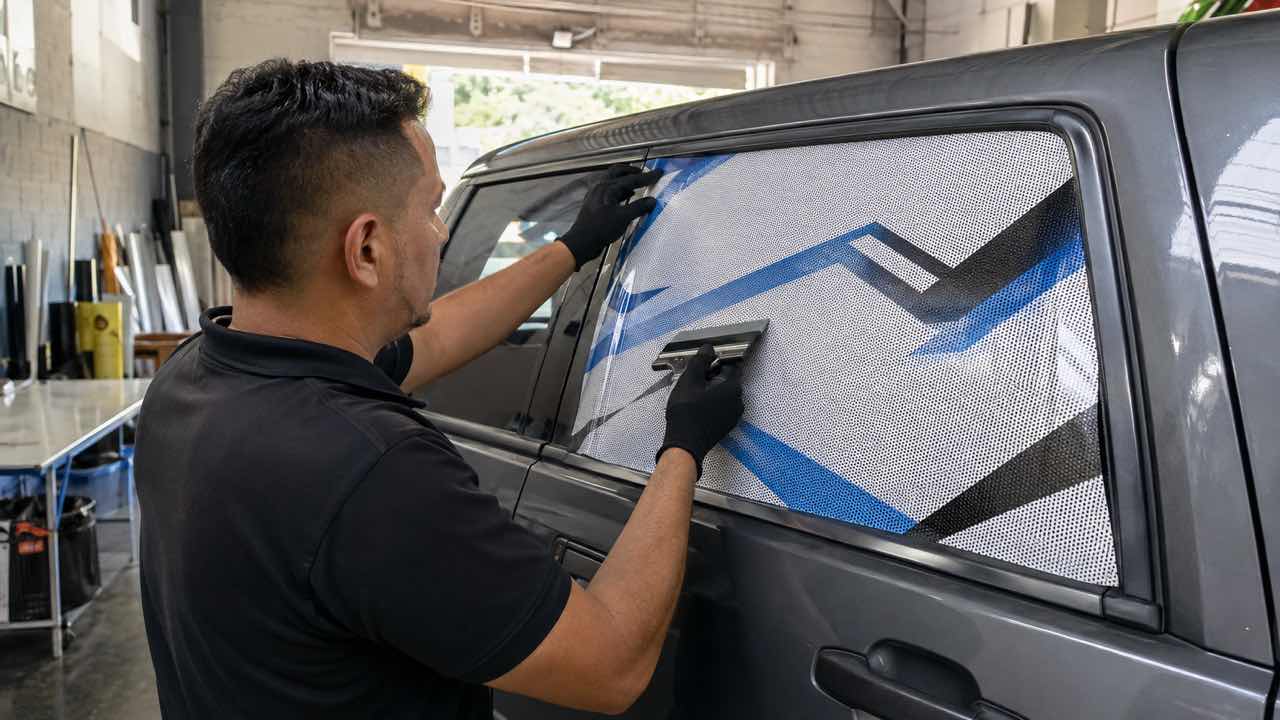
A commercial ratio such as 50/50 describes how much of the film is perforated and how much remains available for printing, but it does not certify the legal visibility of the installed combination. In a vehicle, the film, glass, position and the driver’s required field of view all matter.
Medellín’s outdoor advertising framework also changed through Agreement 026 of March 13, 2025. Before placing advertising on a vehicle or storefront, you should define the category of the element and check the applicable procedure, because not every adhesive graphic is treated in the same way.
A sound choice connects three decisions: how strongly the graphic should appear from outside, how much visibility is needed from inside, and which technical data sheet supports the film. The quote should also separate printing, protection, installation and glass conditions so proposals can be compared.
What is perforated window film?
Perforated window films are adhesive materials with small holes distributed across their surface. One part receives the print while another remains open to allow viewing from inside. The result depends on the material, perforated proportion and glass, so a separate sample cannot replace an assessment of the installed combination.
A 50/50 ratio commercially indicates a split between printable and open area. Other configurations exist: Avery Dennison’s MPI series offers 50/50 and 65/35 in MPI 2000, while MPI 7000 PWF uses 40% open area. Each ratio changes the balance between graphic impact and interior visibility.
Construction also varies. The MPI 2529 PWF data sheet, for example, describes 180-micron polymeric calendered PVC, a flexible film manufactured through rollers, with a 50/50 perforation pattern and 2 mm holes. These specifications identify one product; they should not be applied to every film sold as perforated. Review the material data sheet.
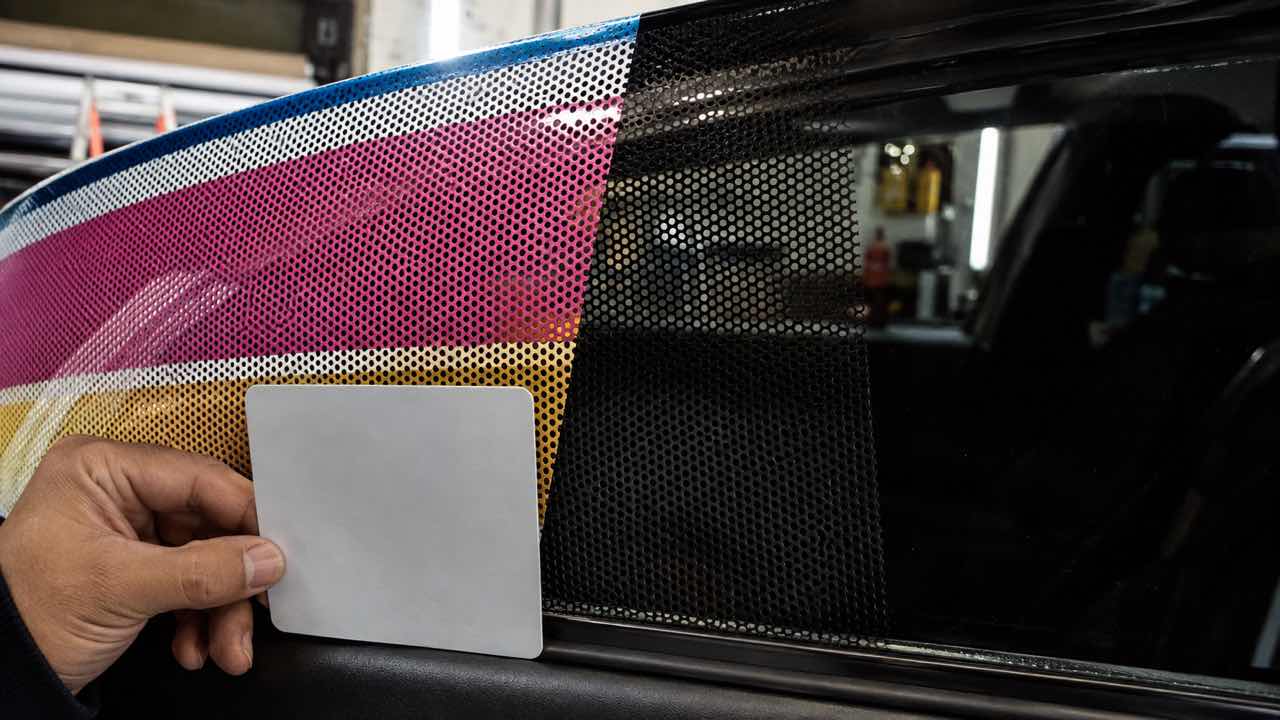
Close-up of the holes in perforated film applied to automotive glass. Illustrative image generated with artificial intelligence.
What are perforated vehicle graphics used for?
Perforated vehicle graphics allow advertising messages on certain glass surfaces while preserving a view from inside through the open area. Their use is appropriate only when placement preserves the visibility needed for driving and the advertising follows the applicable procedure in Medellín.
Safety comes first. Colombia’s National Traffic Code classifies driving with propaganda, advertising or stickers on windows as violation B.11 when they obstruct visibility. Perforations do not remove that obligation. The practical test is not only how the vehicle looks while parked, but what the driver can see from the seat.
- From inside, check mirrors, intersections, pedestrians and nearby vehicles.
- Assess the installed design from the driver’s seat, not only from outside.
- Request the exact product, perforation ratio and technical data sheet.
- Confirm with the district authority whether the advertising installation requires registration.
For a complete project, it helps to coordinate design, production and fitting within one outdoor signage and vehicle branding service in Medellín. This allows the graphic position to be approved before production and makes the included surfaces explicit.
Which perforated film should you choose for glass?
Choose the product by application, not merely by the percentage in its name. The data sheet should state perforation, thickness, adhesive, compatible printing technologies and intended use. For vehicles, confirm that the manufacturer expressly includes vehicle windows and that the installer has assessed the shape and condition of the glass.
Do not confuse open area with visible light transmission. Resolution 3777 of 2003 sets minimums for tinted, colored or darkened glass: 70% for windshields and windows needed for direct vision, 55% for rear side windows, and 14% for rear quarter windows and the fifth door; lower values require a permit. A 50/50 or 65/35 label does not demonstrate that result.
The relevant measurement concerns the installed combination, not an equivalence assumed from a catalog. Read Resolution 3777 of 2003 and seek competent guidance when a project could darken glass required for driving.
- For the graphic: printable area, expected resolution and viewing distance.
- For visibility: open area, window position and lighting conditions.
- For installation: curvature, seals, windshield wipers and surface condition.
- For purchasing: complete product reference, lot or traceability offered by the supplier, and warranty scope.
How does perforated film work on windows?
It works by dividing the surface between printable film and small open spaces that allow viewing from inside. The selected ratio changes that balance between graphic impact and vision. If water or dirt fills the perforations, visibility can deteriorate, so protection and care matter.
The MPI 2529 PWF data sheet recommends an optically clear overlaminate—a transparent protective film—to prevent water and dirt from filling the holes. It also lists compatibility with latex, eco-solvent and solvent printing. The correct protection must match the product and ink system.
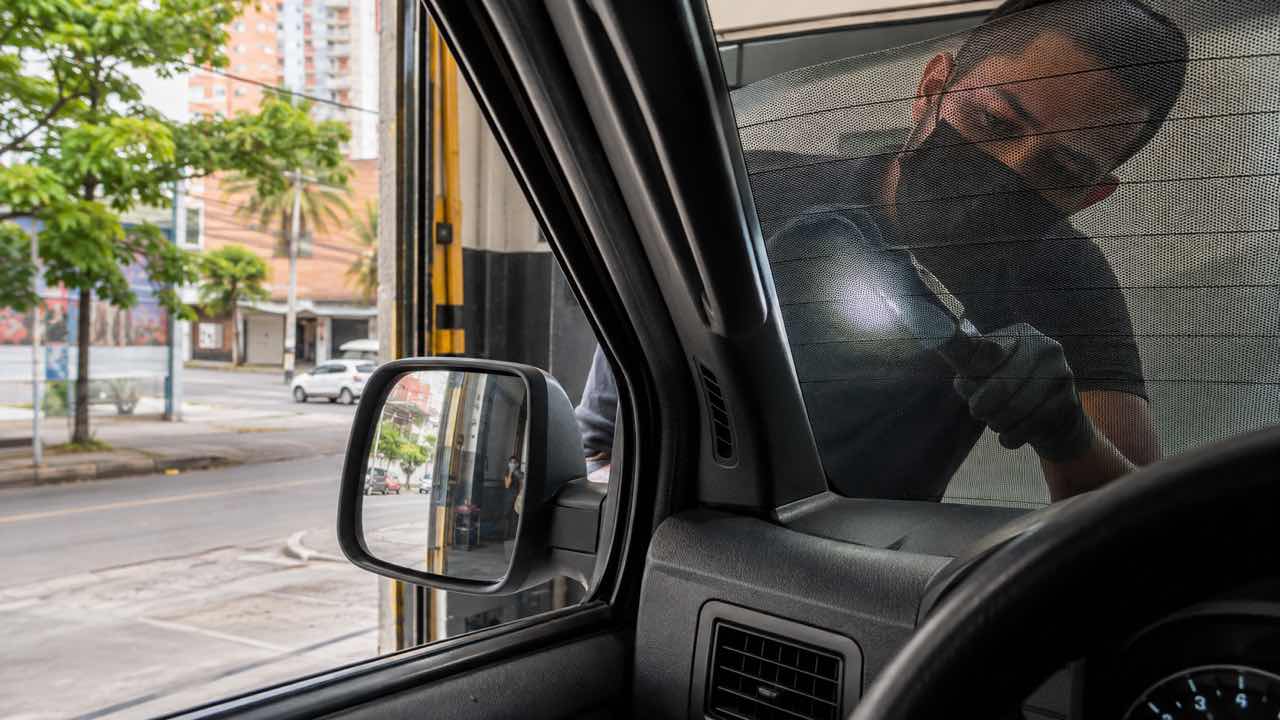
View from inside a vehicle through a window covered with perforated film. Illustrative image generated with artificial intelligence.
For that product, solvent or eco-solvent printing requires five days of curing before lamination or installation. This period is not a rule for every perforated film: it depends on ink, equipment, material and finish. Ask the quote to state when installation can occur, not just when printing is complete.
Perforated films based on PET, the base material in this PVC-free alternative, are available internationally. Contra Vision presents its Advance line with a thinner face film and a lower carbon footprint than its PVC equivalent, but the decision must also consider printability, conformability, durability and end of life. International existence does not guarantee local stock or recycling.
How much do perforated graphics cost in Medellín?
There is no public, comparable average price for Medellín that supports rigorous budgeting. Cost changes with area, product reference, ink, protection, installation complexity and quantity. The useful comparison is to request the same technical scope from each supplier and examine exactly what each offer includes.
Before accepting a figure, ask whether it includes artwork preparation, cleaning, removal of old material, overlaminate and travel. Also confirm the perforation ratio and the life offered by the supplier. Compare equivalent products and deliverables, not only the proposal total.
- Dimensions and number of windows, with photographs or a site visit when needed.
- Film reference, perforation ratio and attached technical data sheet.
- Printing system, intended protection and required time before installation.
- Design, proofs, installation, prior removal, travel and taxes listed separately.
- Written warranty conditions, exclusions and aftercare instructions.
What is the price of perforated film per meter?
A standalone price per meter does not describe the final project cost, and there is no single rate across print providers. First confirm whether the unit is a linear or square meter, the roll width, the offered film, and whether printing, protection and installation are included.
A storefront and a vehicle window do not necessarily represent the same installation scope. Ask the supplier to state the billable area and explain its calculation, along with preparation, cutting and fitting. This lets you compare unit prices without assuming that every proposal measures the project in the same way.
If the vehicle carries outdoor advertising, review the process before committing to a date. The district registration procedure for advertising on vehicles lists documents such as a Mobility Secretariat opinion, vehicle registration card and, when applicable, the owner’s permission and a contract stating the display period; the City reports a 60-business-day response time.
A well-defined purchase ends with three approvals: artwork and placement, material data sheet, and commercial scope. The best quote makes clear what will be installed, where, and under which conditions. That clarity protects visibility, prevents comparisons between unlike products and reduces changes after printing.