By Azabache Producciones on
Food folding cartons require validated materials: paperboard alone is not enough
Materials, labeling and end use define a food carton; paperboard alone does not guarantee a packaging solution is suitable.
A paperboard box can seem straightforward until it contains food. Paperboard alone does not determine whether packaging is suitable: intended contact, inks, adhesives, barriers and printed information all change the assessment.
That intersection of packaging and product matters from the first layout. In Colombia, packaging intended for food or beverages is subject to sanitary requirements; an outer carton for a sealed product is therefore assessed differently from one that touches it directly.
Folding cartons in Medellín are better defined when the brand team, the food owner and the packaging producer share the intended use before approving artwork. This gives the design room for labeling and lets the technical specification inform the quotation.
What are folding cartons and what should be defined first?
Folding cartons are paperboard packages supplied flat and formed by folding. Their structure depends on the product, channel and handling, not appearance alone: weight, dimensions, stacking, transport and closure determine the solution worth developing.
The substrate—the material printed on—needs to be described with the finish, die-cut and run length. A die-cut is the tool that cuts and scores folds. Without these variables, no unit price or lead time is comparable across print providers.
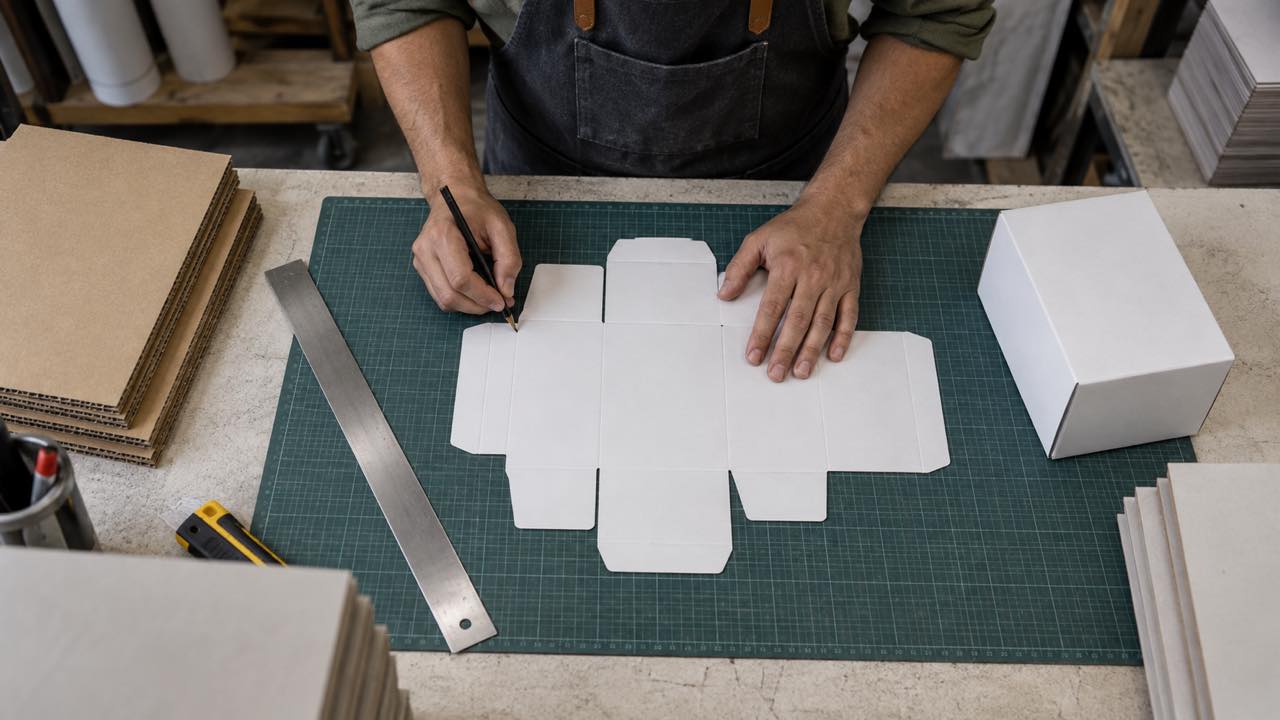
Paperboard sample, die-cut plan and assembled folding carton. Illustrative image generated with artificial intelligence.
The choice between digital and offset printing also depends on the order. A commercial projection of Colombia's market identifies digital as the fastest-growing technology, with a projected 9.12% annual rate through 2031; that growth does not mean it always has the lowest unit cost. Artwork changes and short runs often belong in that discussion.
What changes when folding cartons are for food?
When a carton is intended to contact food or beverages, its materials are validated for that specific use. Resolution 683 of 2012 covers materials, articles, packaging and equipment; paperboard, inks, adhesives and barriers need to match the intended contact.
Not every carton plays the same role around food. It may be an outer pack protecting an already sealed product, or part of the system containing it. This difference shapes the technical documentation normally needed and prevents one material combination from being presented as suitable for every application.
- End use: whether the carton touches food, contains it indirectly or only displays it.
- Conditions of use: humidity, grease, temperature, storage time and transport.
- Components: paperboard, inks, adhesives, laminates and other barriers in the piece.
How should labeling appear on a food folding carton?
Labeling is not added at the end as decoration. For packaged foods within its scope, Resolution 810 of 2021 addresses nutrition and front-of-pack warning labels; since June 15, 2024, non-compliance entails removal from the market, according to the regulation compiled by INVIMA.
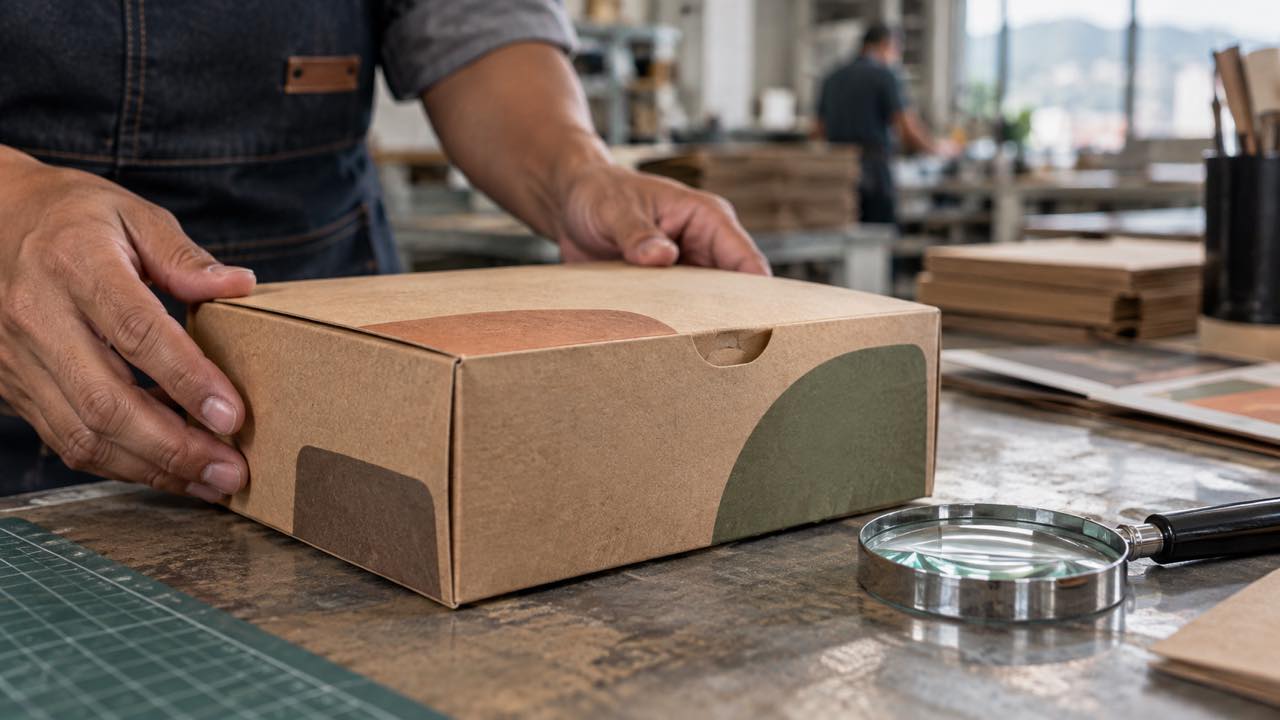
Generic food carton with information areas and a magnifying glass. Illustrative image generated with artificial intelligence.
In practice, this makes artwork a coordination piece. The brand needs to reserve legible areas for applicable information and keep controlled design versions. A change in flavor, serving size or composition may require adjusting the visible face of the carton before another production run. A physical sample before the run helps review assembly, closure, readability and product placement.
Artwork review belongs after the product owner has defined the regulatory information. The printer reproduces approved files and provides production variables; compliance of label content belongs to the role assigned by the regulation, rather than to a general packaging promise.
Does a paperboard carton solve packaging circularity on its own?
A paperboard carton can create options for redesigning components, but it does not automatically make every solution suitable, lawful or recyclable in every setting. Law 2232 of 2022 establishes a gradual reduction of 21 single-use plastic products; elimination began with eight products in July 2024 and reaches 21 in 2030.
That schedule refers to products defined by the law, not an automatic equivalence between plastic and paperboard. Protection from humidity, grease or transport may require other components, which are also part of the assessment. Packaging performance and food safety remain project conditions.
It is also useful to distinguish an environmental claim from certification. Communicating an FSC claim on a carton requires certified chain of custody, covering sourcing, processing, labeling and sales under FSC-STD-40-004. The current certificate and its scope need to match the product and the claim offered.
What should a folding-carton quotation in Medellín include?
A useful quotation turns a commercial need into comparable specifications. It should describe the substrate, final size, die-cut, inks, finishes, run length and delivery; cost and lead time vary with that combination. A standalone figure does not show whether two proposals solve the same carton.
For a food brand, the conversation starts with the carton’s function and continues with the information it must carry. Developing packaging and labeling for products in Medellín helps organize these decisions before production begins.
Mordor Intelligence projects Colombia's folding-carton market to rise from USD 395.42 million in 2025 to USD 423.18 million in 2026. This is a projection by a research firm, not an official statistic; it provides context rather than replacing a specification or a current quotation.
A well-planned folding carton brings together three decisions: protecting food for its actual use, making room for applicable information, and defining production for the run length. This early precision reduces last-minute changes and helps packaging work both on shelf and in operations.