By Azabache Producciones on
Recycled paper alone does not make a piece sustainable: adhesives and coatings also count
Material selection means reviewing use, ink, finishing, and recovery of the whole piece—not only fiber origin or paper weight.
Recycled paper alone does not make a printed piece sustainable. Ink, adhesive, coating, other surface layers, and the way the product will be recovered also change the outcome. Even a material called paper can be difficult to recover when the finished piece combines incompatible components.
Selection should begin with the final use, not with an attractive sample. Define how long the piece must last, how it will be handled, which method will print it, and whether it needs stiffness, folding, writing, adhesion, or moisture resistance. Then compare available references and manufacturer data sheets.
The B2B conversation now covers the whole system. Andigráfica 2025 highlighted eco-friendly adhesives, solvent-free coatings, and the joint evolution of inks, substrates, and adhesives. A substrate is the material that receives the print: it can be paper, board, plastic, wood, metal, glass, or textile.
What are the types of paper used for printing?
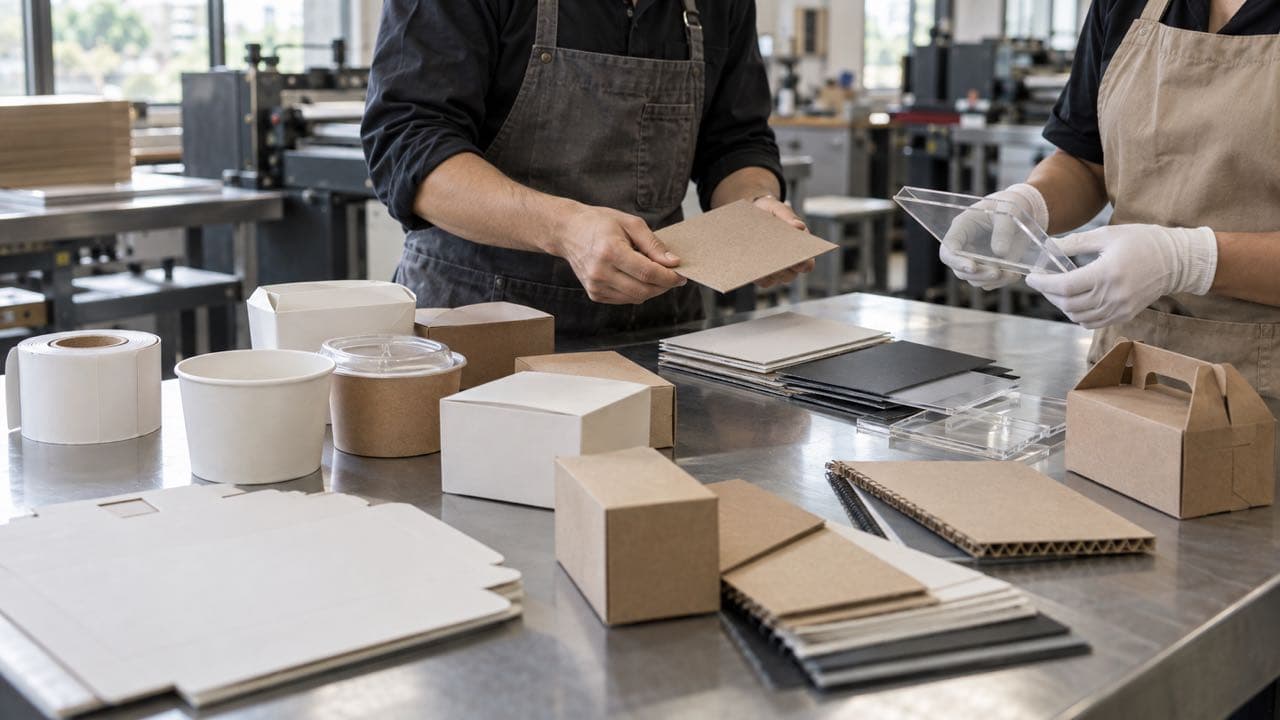
The most useful decision groups are uncoated papers, coated papers, paperboards, and self-adhesive materials. Whiteness, texture, opacity, stiffness, and basis weight vary within each group; basis weight is the paper's weight per square meter. A trade name does not replace a technical data sheet or a production test.
Uncoated papers generally accept writing, stamps, and a tactile appearance well. Coated papers provide a more uniform surface for photographs and solid color areas. Paperboards add body, while self-adhesive stocks combine a printable face, adhesive, and release liner; every layer matters when assessing the complete piece.
- Internal communication: legibility, opacity, and the ability to write or stamp.
- Promotional material: image reproduction, handling resistance, and finishing.
- Packaging or labels: folding, adhesion, intended contact, moisture, and recovery route.
- Long-life pieces: stability, exposure, and compatibility among ink, material, and protection.
There is no single best paper type for every job. A pleasing texture may reduce photographic definition; a very smooth surface may not be ideal for writing; a protective layer may extend service life but also alter recovery. The function of the piece determines the priority.
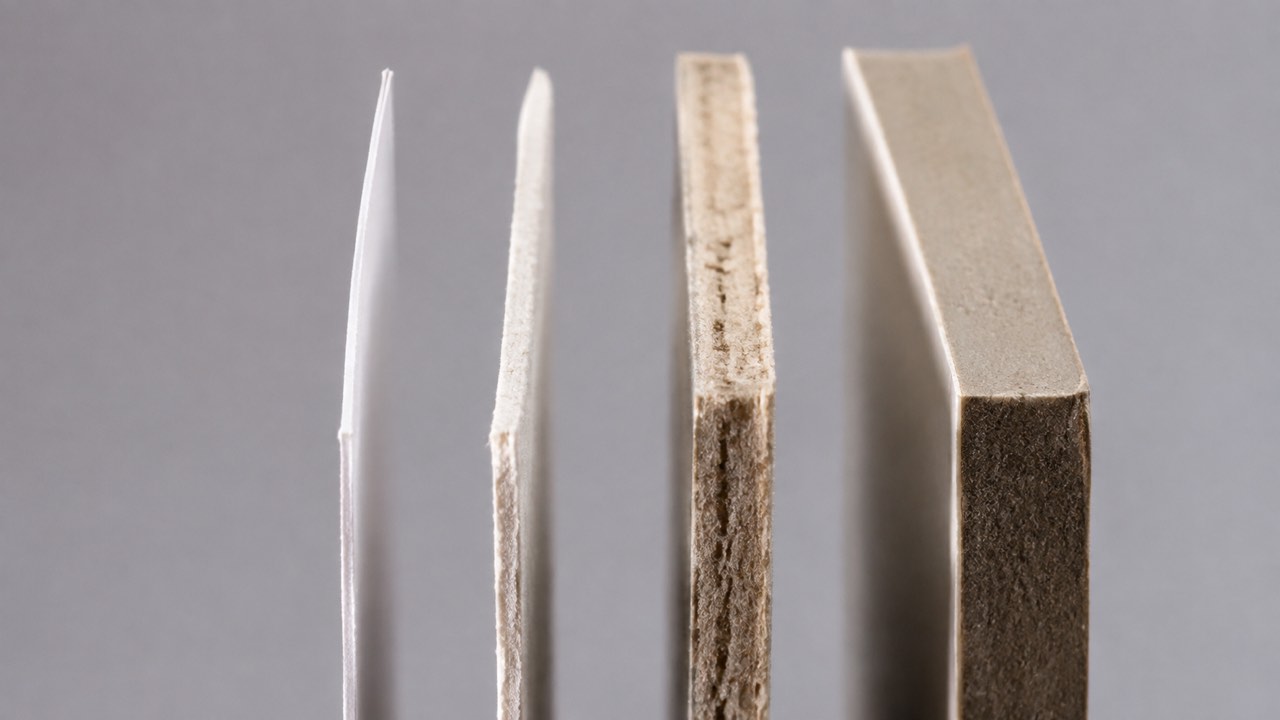
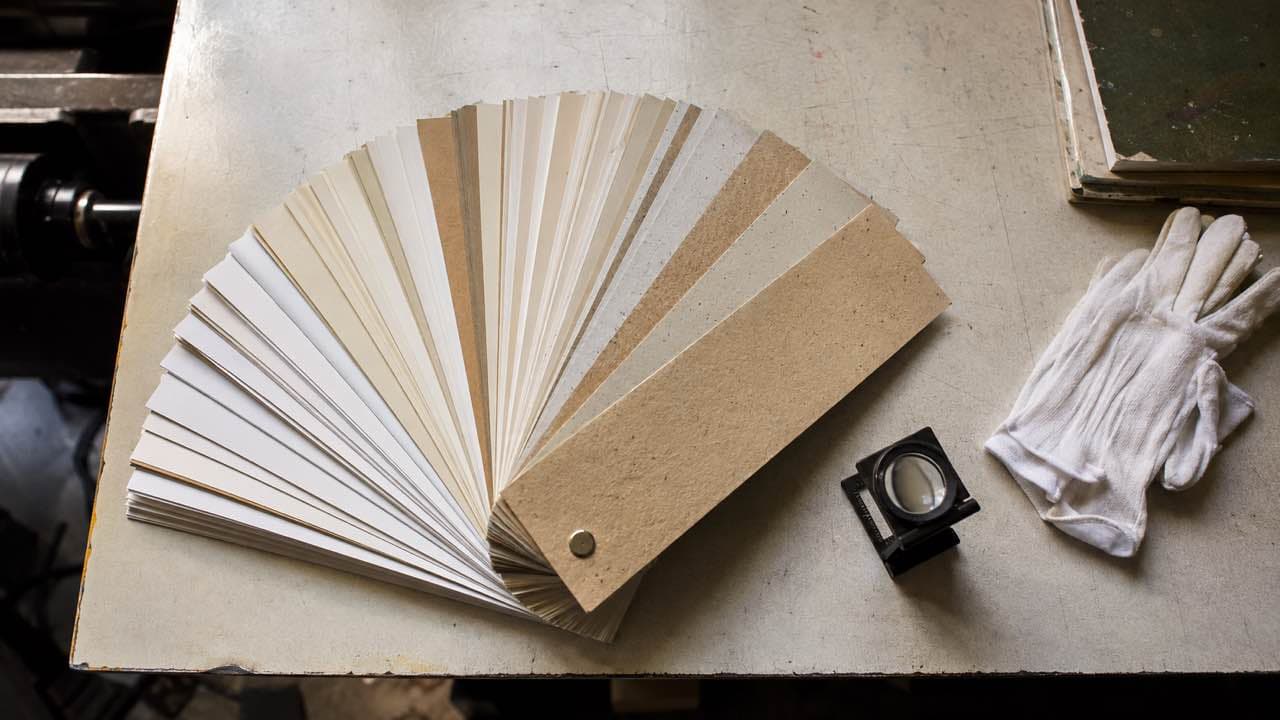
Edges of papers and paperboards with different thicknesses, textures, and coatings. Illustrative image generated with artificial intelligence.
What types of paper work for printing cards?
Rigid coated or uncoated paperboards work for cards when selected for the image and intended use. A stable surface matters for photographs or even color fields; if the card must accept a signature or note, writing should be tested. Evaluate the finish and printing method with the exact stock.
A corporate card is not defined only by its thickness. Fiber direction matters for folding, opacity matters when both sides are printed, and cut edges and surfaces must respond cleanly. Cost varies with the stock, basis weight, run length, finishing, and available inventory.
A physical proof resolves questions a screen cannot show. It allows the team to review touch, stiffness, contrast, drying, writing, and the difference between projected and printed color. When identity depends on a precise tone or special finish, agree on approval conditions before producing the full run.
Which heavy paper is suitable for corporate print pieces?
Choose a paperboard that provides the required stiffness without hindering printing, folding, or cutting. Basis weight is a guide, but it does not describe thickness or firmness by itself. Two stocks with the same basis weight can feel different, so use a sample, technical data sheet, and test of the intended process.
Structure comes first in folders, covers, and information cards. A folding piece requires a check of fiber direction and, depending on the stock, a crease that guides the fold. If it also uses lamination or coating, verify that the finish withstands handling without cracking or separating.
The “sustainable” label requires evidence about the stock and its final configuration. ECLAC documented in 2025 local experimentation with new materials, including bioplastics, but this does not show that all are recyclable or compostable. Composition, coatings, adhesives, inks, and the local recovery system determine whether that claim is appropriate.
What types of paper work for printing books?
Book interiors generally call for uncoated or coated papers according to the content. Continuous text needs comfortable reading, opacity, and manageable volume; photography needs reproduction quality and detail. Specify the cover separately because it must protect, fold, and work with the chosen binding rather than imitate the inside pages.
Higher basis weight does not always mean a better book. It can increase spine width, weight, and page-turning stiffness. Paper that is too transparent shows printing from the reverse; a highly glossy sheet can create uncomfortable reflections during sustained reading. Page count and format change the balance.
The layout must be prepared for the actual process. Bleed, an image extension beyond the trim line, prevents unintended white edges; margins, imposition, spine width, and image reproduction also need review. A bound sample lets the team assess opening, sequence, and touch before the full print run.
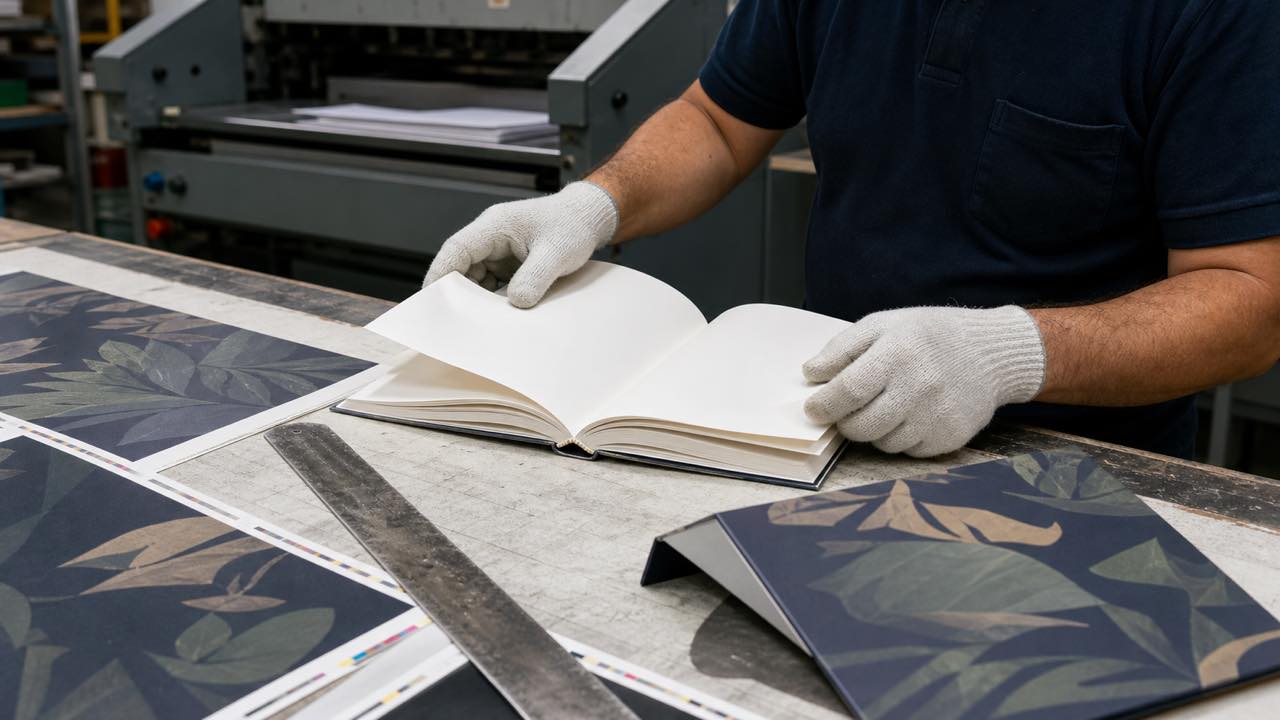
Person checking the opening and spine of a printed book mockup. Illustrative image generated with artificial intelligence.
What types of paper work for printing stickers?
Stickers need a self-adhesive material compatible with the surface, environment, and expected lifetime. The printable face is only one part: adhesive and liner also determine performance. Paper and plastic film serve different uses, and adhesives do not behave equally on glass, board, curved surfaces, or refrigerated items.
Test a sample on the real surface before production. Observe initial adhesion, permanence, removal, expected moisture, temperature, and abrasion. If the piece includes protection, also verify compatibility among ink, lamination or coating, and material; a poor combination can lift even when each component works correctly on its own.
Coated paper or Propalcote: which one should you choose?
There is no universal technical equivalence between coated paper and Propalcote. The names may group stocks with different properties depending on manufacturer and market. Compare the specific data sheet, printing equipment, finish, and intended use, and physically review whiteness, gloss, stiffness, texture, and color response before choosing.
Responsible purchasing treats the piece as a chain of compatibilities. Material, ink, adhesive, and coating must work together and suit the destination. If an FSC claim is required, verify the supplier's current certificate and the scope applicable to the product; recognizing a logo or requesting “certified paper” is not enough.
A useful specification ends with a verifiable stock, not a generic name. Azabache's material and prepress consulting in Medellín can organize the project's variables: use, lifetime, surface, printing, finishing, handling, expected recovery, run length, and availability.
Confirm availability before closing the design, campaign, and schedule. There are no comparable public data that support promises of specific prices or lead times in Medellín. An international signal of capacity adjustment does not prove local scarcity: stock, basis weight, quantity, finishing, and current inventory still determine the quotation.