By Azabache Producciones on
A shelf display must reserve space for unit pricing: its base can remain in use
A reusable base with interchangeable inserts makes campaigns and price changes easier without producing the entire display again.
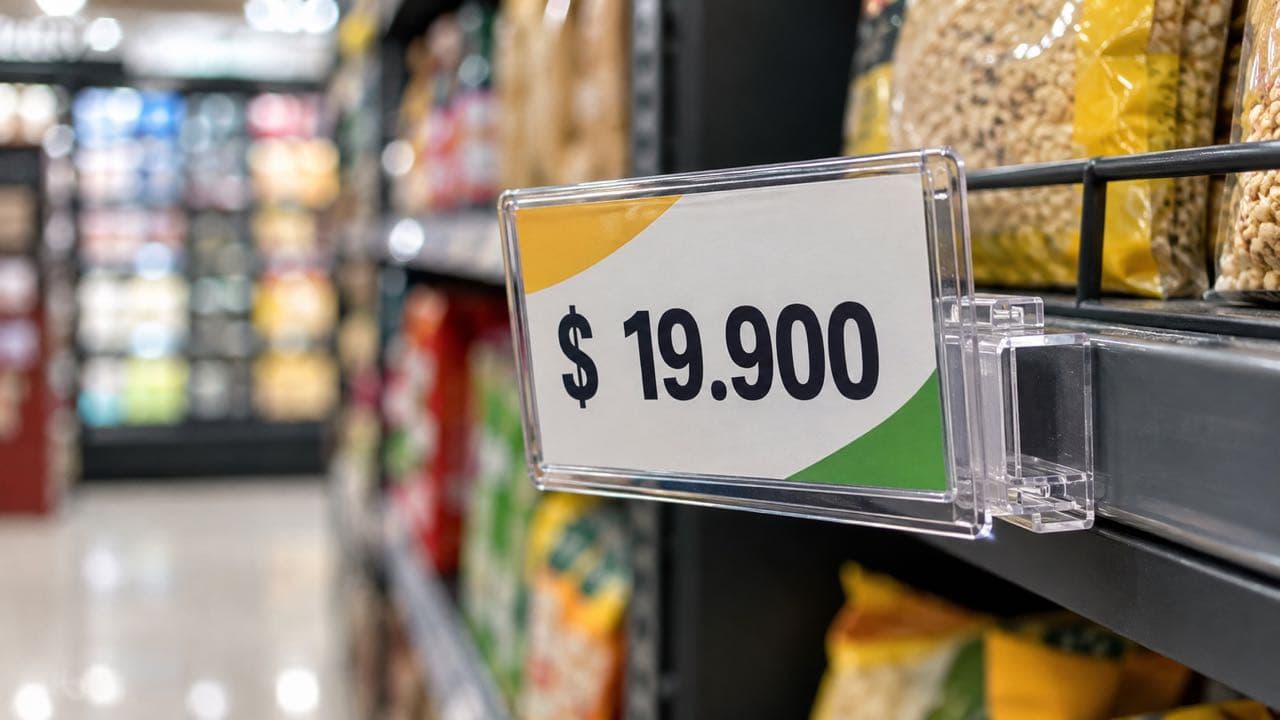
A shelf display intended for products subject to unit-pricing rules must reserve legible space for that information. A base with replaceable graphics makes it possible to update prices and campaigns without producing the entire structure again, provided that every version is clearly controlled.
Advertising displays in Medellín can use a reusable base with interchangeable graphics. This system separates the durable structure from the changing message, a useful choice for prices, seasons, launches, and limited editions.
The choice is not limited to acrylic or polystyrene. Material, size, printing, finish, quantity, and place of use form one system; a quote and production schedule only become meaningful once those variables are defined.
What are advertising displays?
They are point-of-purchase pieces that present a message next to a product or at a service point. They may show a price, benefit, instruction, launch, or digital access. Their format depends on where they rest or attach: table, counter, window, shelf, or gondola.
A modular display keeps the base and replaces the printed insert. Modularity reduces the need to manufacture the entire structure again for every campaign and makes expired versions easier to remove, provided the format, fastening, and update process are defined during design.
An Italian study of retail printing reported more seasonal window displays and fewer permanent fixtures and display systems in 2025. Although it does not describe the Colombian market, it is a useful signal of more tactical, renewable demand. The study also recorded a 44-percentage-point rise in customization for limited editions. Read the FESPA Italia research.
Which is better for displays: acrylic or polystyrene?
The right material is the one that suits the use, lifespan, and graphic replacement system. Acrylic and polystyrene should be compared using the same dimensions, quantity, location, and finish. Neither is the automatic answer for every project, and the decision should be supported by an approved sample.
The comparison should cover the substrate, the material onto which the image is printed, as well as stability, cleaning, edges, weight, transport, and replacement. A physical sample helps assess color, rigidity, and assembly before the production run, especially when the piece must hold inserts or remain near customers.
FESPA has also documented fiber boards for POS applications and transparent PVC-free PET films. Their availability and actual recovery must be confirmed with the supplier and the local disposal pathway. A material alone does not make a piece sustainable: ink, adhesive, finish, transport, waste, and end of life also matter. See FESPA's life-cycle approach.
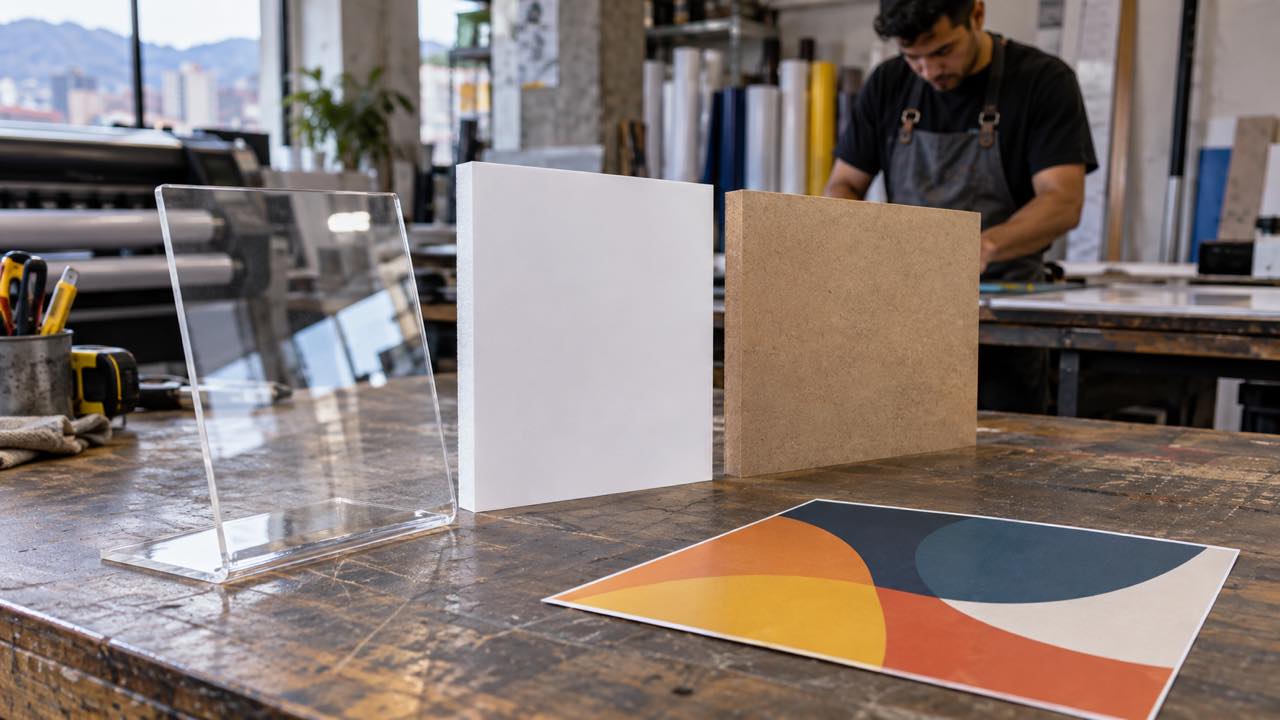
Acrylic, polystyrene, and fiber board samples for retail displays. Illustrative image generated with artificial intelligence.
How much do advertising displays cost?
There is no comparable unit price without a common specification. Cost changes with quantity, dimensions, material, printing, number of versions, finish, packaging, delivery, and prototype needs. A standalone figure may compare pieces that look similar but perform and last differently.
Ask for a quote that separates the base, replaceable graphic, finishes, and delivery. Lead time also depends on approved artwork, material availability, run size, and finish; record the approval date, quantity per version, and required delivery date in writing.
- Define the use: indoors, expected lifespan, and exact installation point.
- Provide dimensions: width, height, depth, and the space available beside the product.
- Separate versions: total quantity and units for each design or price.
- Request a sample: assess legibility, stability, insert replacement, and finish before the run.
How can creative advertising displays be designed?
Useful creativity makes one idea visible and keeps the expected action clear. Before choosing a silhouette, define what a person should understand at first glance: price, newness, comparison, promotion, or access to information. Shape, contrast, and finish should support that priority.
In the Italian retail study, the most frequently reported finishes were die cutting, above 60%; gloss or matte varnishes, around 55%; and folding or creasing, above 40%. These are European industry signals, not Colombian market shares. Die cutting is a process that cuts a specific shape.
A practical strategy is to standardize the base and reserve special shapes or inserts for selected campaigns. The piece should be tested in its actual location: reading height, lighting, reflections, stability, distance from the product, and ease of replacement can change an idea that looked right on screen.
How should QR displays be used?
Use a QR code to expand information or measure an action, not to replace the essential message. The display must still identify what people will find after scanning. Destination address, contrast, size, and position require testing with the final artwork and finished piece.
Results must be measured for each campaign with an identifiable address and a specific goal, such as viewing a product sheet, opening a menu, or registering interest. Assigning a different destination to each version can help compare locations or messages, and the code should be tested again after any artwork change.
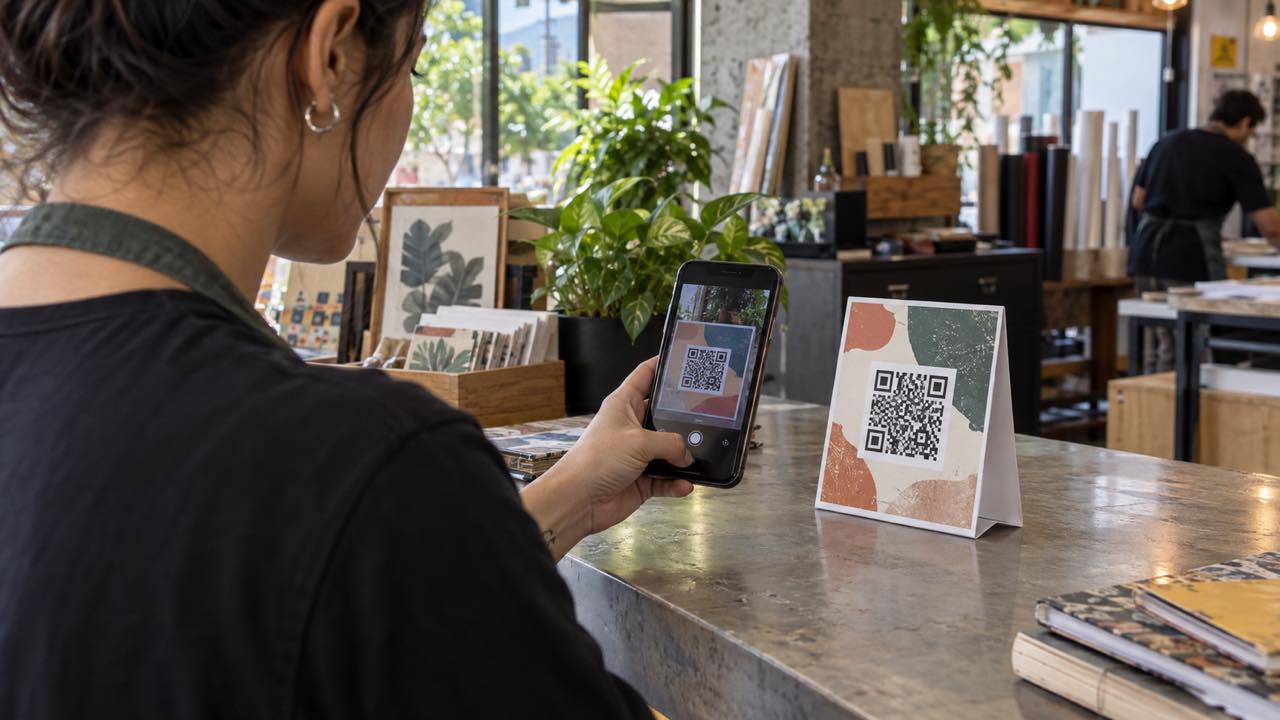
Scanning test of a QR code on a tabletop display. Illustrative image generated with artificial intelligence.
What should supermarket price displays show?
For products covered by the rule, displays must reserve legible space for the total price and the applicable Price per Unit of Measure. The latter expresses value according to a comparable unit. Validity and insert control are functional parts of the piece, not later details.
A replaceable system helps update information without remaking the base, but it cannot correct inaccurate data by itself. The retailer needs to assign responsibility, set validity dates, and review each version before it reaches the shelf. The content applicable to every product should be identified in the production order.
For prepackaged goods over 50 grams or milliliters and bulk products within its scope, the SIC's Single Circular requires the Price per Unit of Measure using International System units. The design must reserve legible space for the total price and the applicable unit price. Read Title II of the Single Circular.
Where can advertising displays be ordered in Medellín?
Choose a supplier that converts the real use case into a verifiable specification before production. The supplier should ask about location, duration, quantity, versions, update method, material, and finish. It is also useful to agree on the sample, assembly tolerances, packaging, delivery, and installation when applicable.
Bring the artwork, space dimensions, and a table listing every version, text, price, and validity period. A single data source reduces late changes and crossed versions. If the structure and graphics must be developed together, describe the project when requesting point-of-purchase advertising and displays in Medellín.
Before approval, assess one finished piece in conditions close to actual use. The final decision should balance legibility, stability, updateability, and the system's total cost. The display then becomes more than an isolated print: it becomes a controllable tool for communicating campaigns and prices.