By Azabache Producciones on
Coated paper or Propalcote: run size and deadline matter as much as finish
Paper selection changes with the intended use, run size and delivery date; finish alone does not settle the decision.
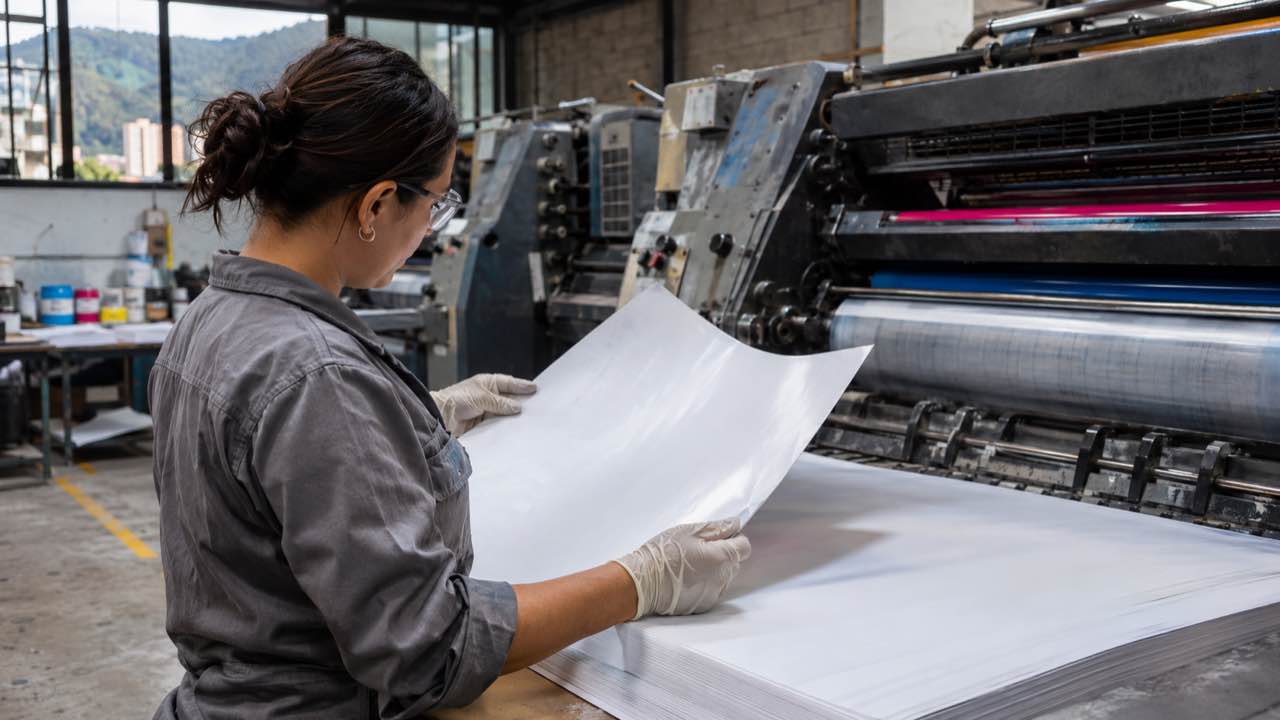
The visible finish is not enough to define a printed piece’s paper. Run size, end use and delivery date also affect the choice between coated paper and Propalcote.
In September 2026, paper, paperboard and related-product manufacturing recorded a year-on-year change of 0.9% in real production, -0.1% in real sales and -3.3% in employment, according to the DANE’s September 2026 EMMET bulletin. Those figures describe sector activity, not the price or availability of a specific paper.
Timing matters because faster deliveries and shorter runs are common industry pressures: an international PRINTING United Alliance survey of 258 companies reported both trends. A material decision becomes more precise when it is quoted together with printing and finishing.
What types of paper work for printing?
The answer depends on the application rather than on a universal list of papers. Printing works as a system in which technology, ink, material and finishing fit the end use. That relationship is highlighted in FESPA’s digital-printing materials guide.
The substrate, the surface that receives the print, may need different properties depending on whether the piece will be handled, displayed or kept. The paper’s appearance should be considered alongside ink, press and the piece’s intended use.
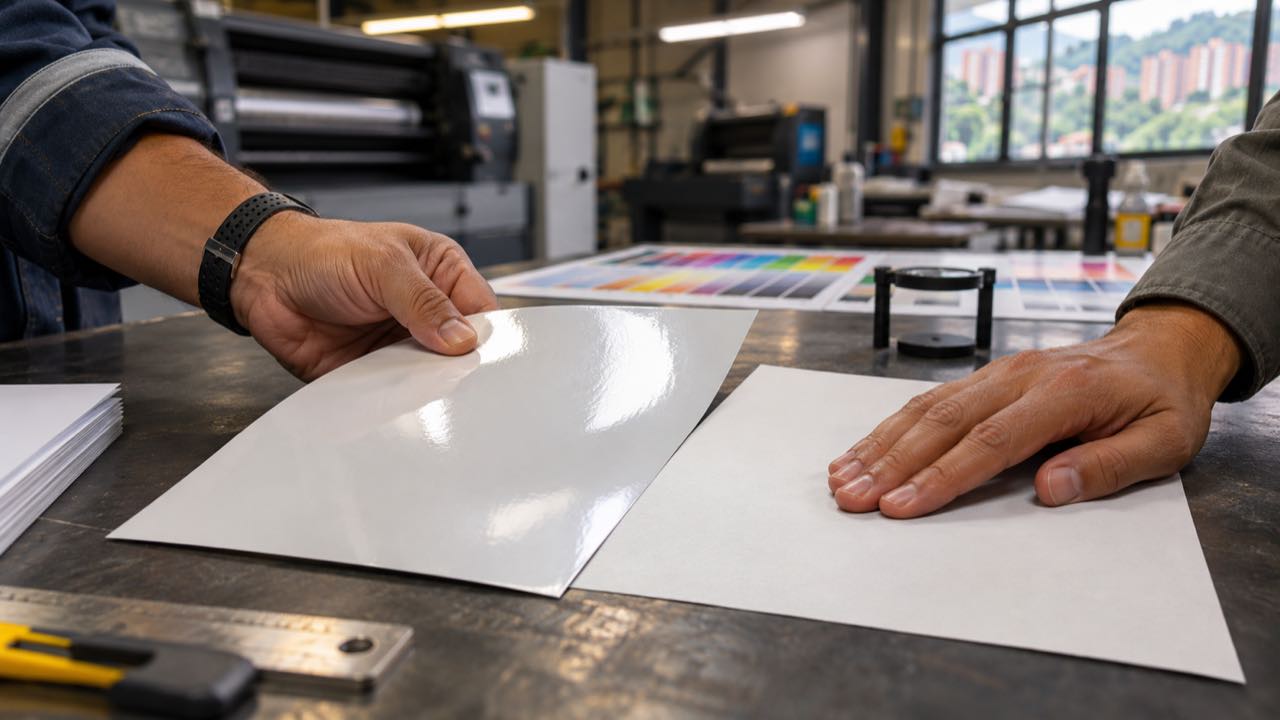
Hands compare gloss and matte paper samples on a prepress table. Illustrative image generated with artificial intelligence.
What paper works for printed cards?
For a card, stiffness and finish shape the experience of holding it, but they do not settle the choice. A card needs a technical specification that matches its weight, printing, finish and use. Paper weight is measured in grams per square metre.
Propal describes Propalcote C1S and C2S as white coated papers with coating on one or both sides, in gloss and matte options. General properties of a paper line do not replace the technical sheet for a specific quote.
What paper allows thicker printing?
Printing on a heavier paper requires checking that the planned press, ink and finish can handle it. A thicker paper changes the production specification, not just the feel in the hand. The useful information is therefore more than the paper-weight number: it is its fit with the project.
Material guidance can turn that fit into a decision before production: design and prepress review for printed materials brings together format, material and final artwork. The appropriate proof depends on the run size and the finishes to be used.
Coated paper or Propalcote?
The comparison should begin by defining the product and the intended result. Propalcote C1S and C2S are described as coated papers, with coating on one or both sides. Propal also cites smoothness, gloss, stiffness, fast drying and surface resistance to picking for this line.
There is no comparable per-copy price across print shops without knowing run size, format, printing and finishing. Cost and lead time change with the full production conditions. Aggregate manufacturing figures for the Aburrá Valley Metropolitan Area also do not determine paper inventories or print-shop delivery times.
What paper is used to print books?
For a book, the choice relates to reading, page count and the production system. Run size and deadline help define the material together with the way the book will be printed and finished. The same option does not necessarily work the same way for a cover and interior pages.
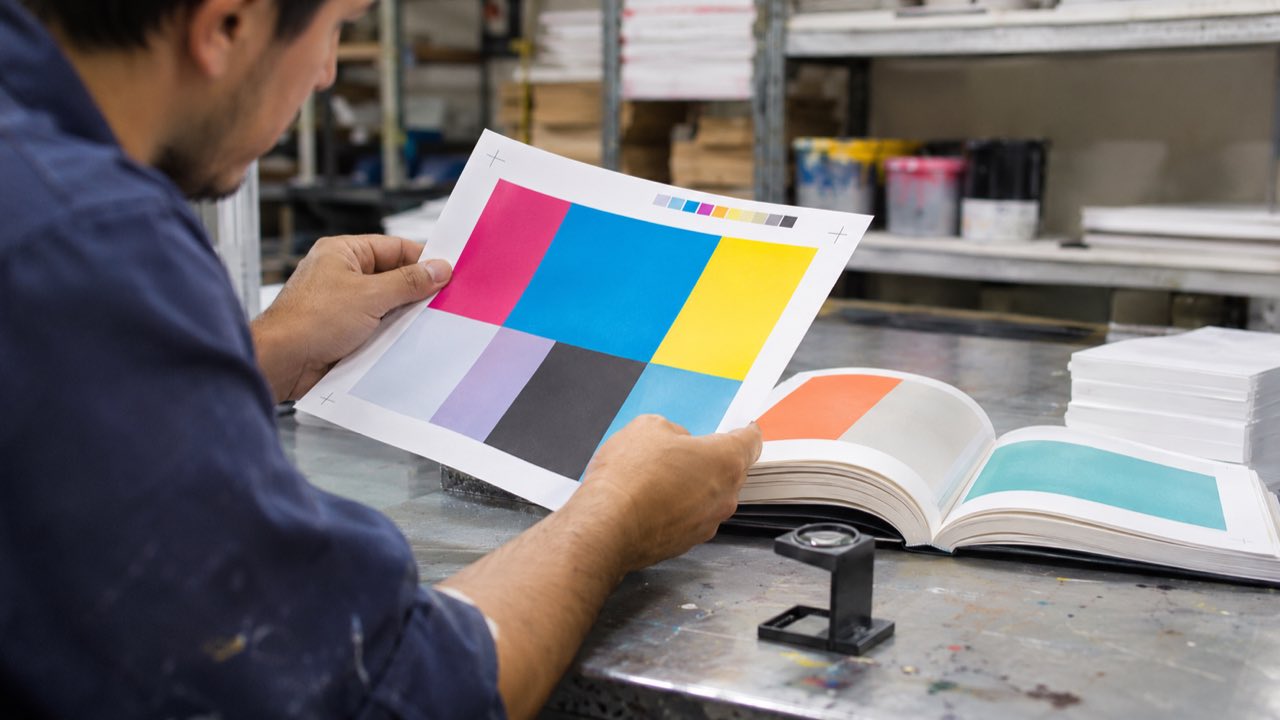
Worker examines a printed proof and an open book in a print workshop. Illustrative image generated with artificial intelligence.
Environmental certification cannot be inferred from a paper’s name. A label applicable to a printed material requires checking the current certificate and its scope. ICONTEC includes printed paper and paperboard materials and printing inks under standards in its Colombian Environmental Seal programme.
What paper works for printing posters?
A poster is selected according to where it will be seen, how long it will be displayed and how it will be installed. The required legibility and resistance change between an indoor display and a piece exposed to handling. Finish is part of that combination, not a stand-alone answer.
When a project has a fixed date, the quote should state material, run size, printing and finishing. Lead time depends on run size and finish, so it should appear in writing in the quote.