By Azabache Producciones on
Corporate reports: the sustainability guide for small businesses sets five principles
A corporate report separates the legally required management report from a voluntary publication and communicates progress clearly.

A corporate report does not become stronger by accumulating pages, but by making an organization’s progress understandable. Clear, verifiable information turns a report into a useful piece for its readers.
Colombia’s Superintendency of Companies prepared the Sustainability Guide for SMEs, shared by the National Institute of Public Accountants of Colombia, with a practical, flexible approach proportional to each organization’s resources. The guide works as a management tool that adapts to each company’s capabilities.
That flexibility does not replace corporate obligations. At the end of each fiscal year, administrators must submit the management report, general-purpose financial statements with notes, and a profit-distribution proposal to the shareholders’ meeting or partners’ board under Law 222 of 1995. The management report required by law and an editorial publication serve different purposes.
The choice to print, bind, or distribute a digital version belongs to the editorial project, not to a requirement of the guide. A report’s format depends on its audience, content, and circulation method. An editorial production service for corporate reports in Medellín can turn that decision into a coherent publication.
What should a corporate report communicate in Medellín?
The city alone does not determine the content: the report starts with the issues that truly affect the company and its audiences. A report gains credibility when it explains concrete progress and its limitations.
The guide organizes this approach around materiality, proportionality, integration, continuous improvement, and transparency. Materiality means focusing on the issues that matter most to the organization and its related groups. Transparency requires progress to be communicated clearly, verifiably, and consistently.
Is there a comparable price for corporate reports?
There is no comparable per-copy price among printers because the cost changes with the print run, page count, size, paper, and finish. Two reports with the same page count can require different production processes.

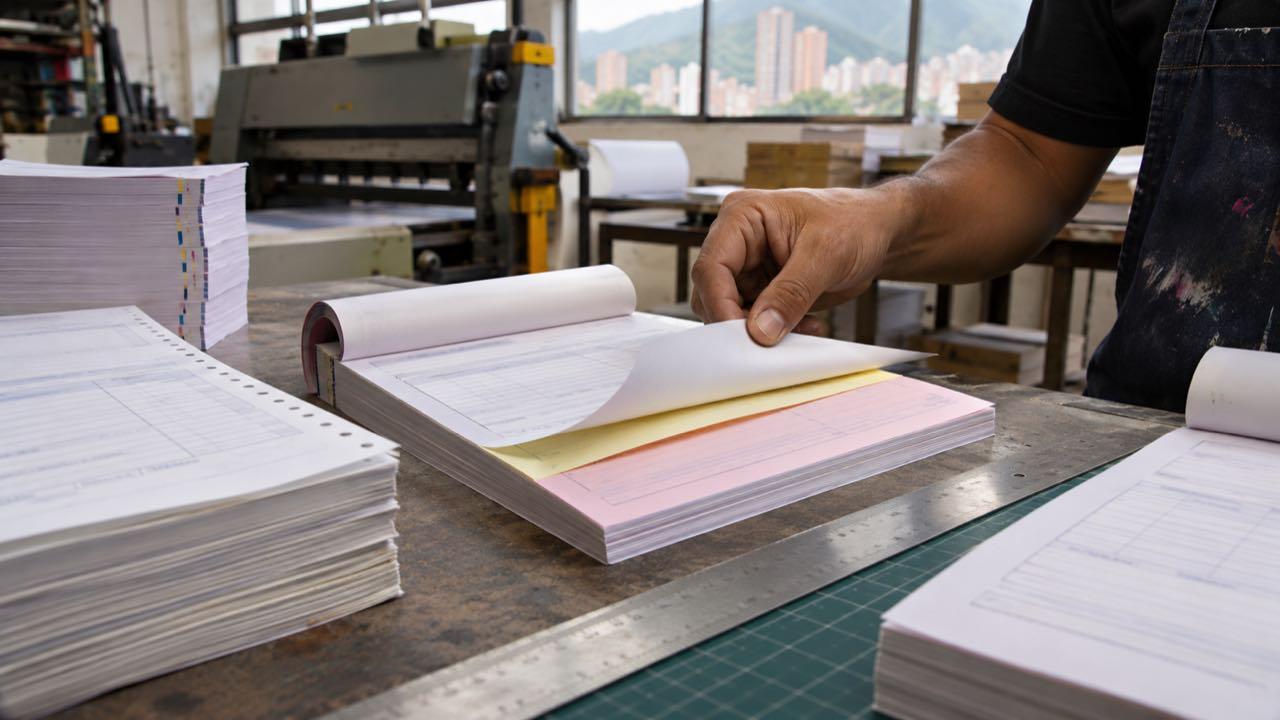
Open corporate report beside paper samples on a production table. Illustrative image generated with artificial intelligence.
Paper weight, which expresses the paper’s mass per square meter, and the binding type also change the result and quotation. A useful quotation describes the publication’s specifications as well as its quantity. Lead time also depends on the print run and finish, so it is best stated in the proposal.
When does it make sense to include a USB with a report?
A USB drive can deliver digital files alongside a printed publication, but it does not automatically replace reading on paper or turn content into a corporate report. A digital medium makes sense when it suits how the audience will consult the files.
Searches for personalized USB drives often refer to a promotional or delivery object, whereas a corporate report is a content piece. Personalizing the medium does not replace selecting and organizing the information. Capacity, included files, and update method depend on the project and supplier.
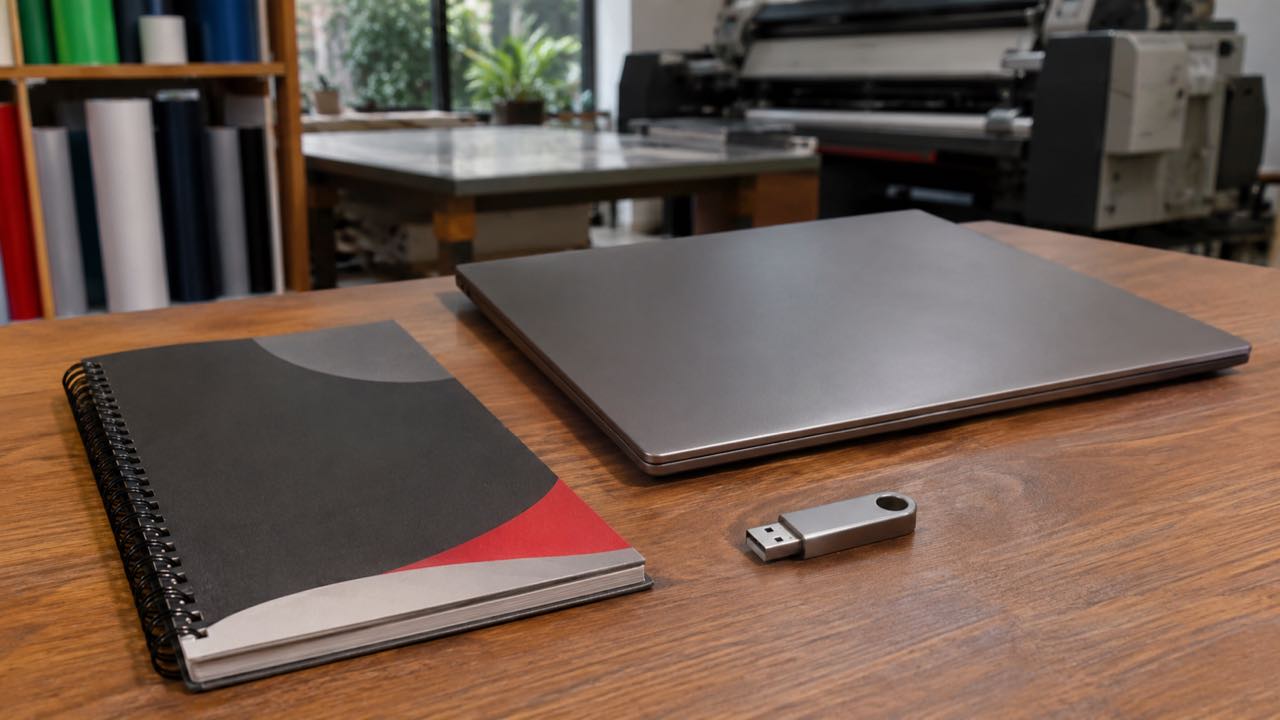
USB drive beside a printed corporate publication on a desk. Illustrative image generated with artificial intelligence.
Is a sustainability report mandatory for every company?
Not every company is required to publish a sustainability report: the guide presents it as a voluntary management tool. A publication can give context to progress without becoming a general printing requirement. The guide also includes an Excel self-assessment matrix that rates each company’s maturity at four levels: incipient, basic, intermediate, and advanced.