By Azabache Producciones on
A draft decree for Plaza Mayor would ban video toward arterial roads: digital totems would show still images
The Plaza Mayor regulatory proposal brings light control and simple messages into decisions about exterior totems.

An exterior totem can guide people, identify a site, or show a brand from a distance, but its illuminated element changes the conversation when it stands near a main road. Planned digital content can shape the design from the outset.
In Medellín, the Provisional Decree Proposal 1720186717 for Plaza Mayor’s Special Regulatory Area accepted public participation from March 10 to 16, 2026, according to the Medellín Mayor’s Office, Regulatory Projects and Agenda. The published text is a proposal, not a final decree.
The proposal refers to high-energy-efficiency technologies and light control, two criteria relevant to potential illuminated totems. Lighting becomes more than a finish; it becomes a location decision. Exterior signage and vehicle branding projects in Medellín are often defined more clearly when the relationship between structure, light, and surroundings appears in the initial plan.

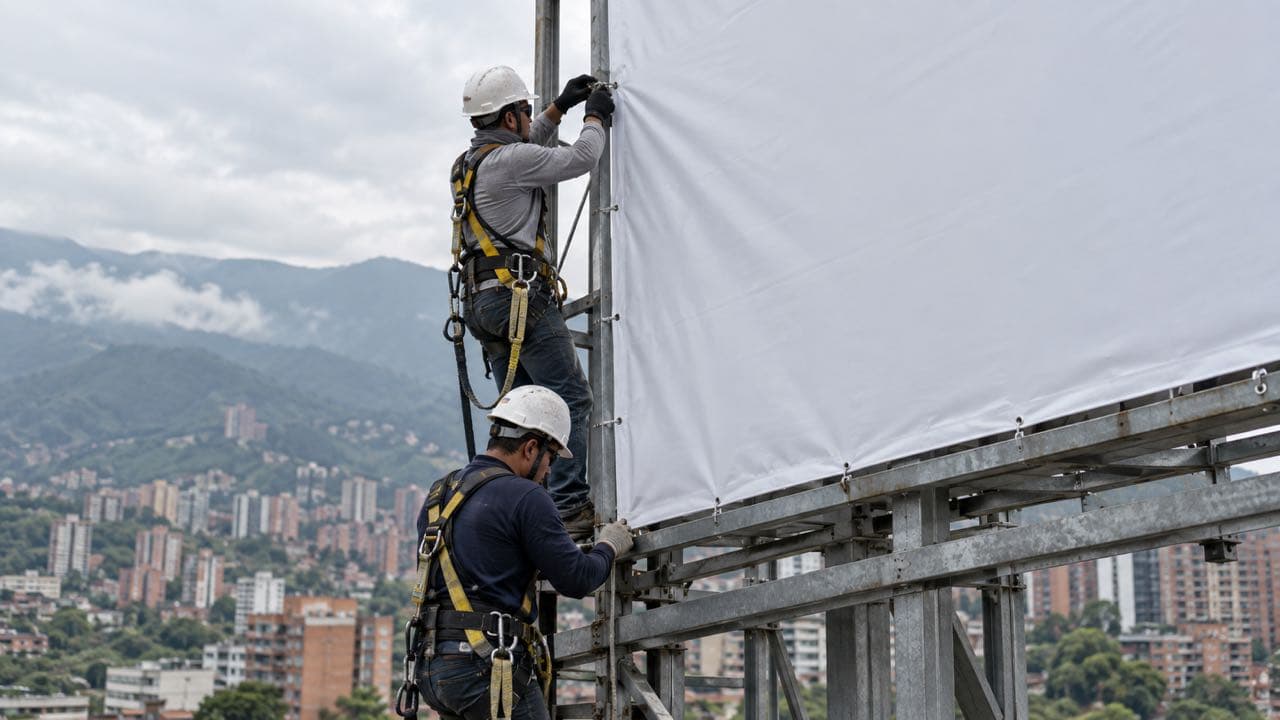
Designer reviews an exterior totem plan with a lighting sample. Illustrative image generated with artificial intelligence.
What are exterior totems?
Exterior totems are vertical signage structures installed outdoors to identify places, guide routes, or give a brand presence. How they are read depends on distance, height, and light together. A single format can therefore use fixed information or an illuminated face, depending on the location and its purpose.
Under the ARE proposal, messages facing Autopista Sur, Autopista Norte, Vía Regional, and arterial roads must be simple. Proposed electronic or digital pieces would not include video in those directions. Instead, the text provides for images or messages with a defined display time, known as spots.
The same approach would extend to advertising that is not beside those roads but faces them within a 100-meter radius. The direction of a visible face can matter as much as the totem’s direction. This means placement cannot be settled solely by the available point on a property.
How should exterior totems be chosen?
The choice starts with the sign’s purpose, the place where it will be seen, and the type of content it will show. A totem with changing information needs a different assessment than a static one. If it faces the roads named in the document, message simplicity and light control become central to the definition.
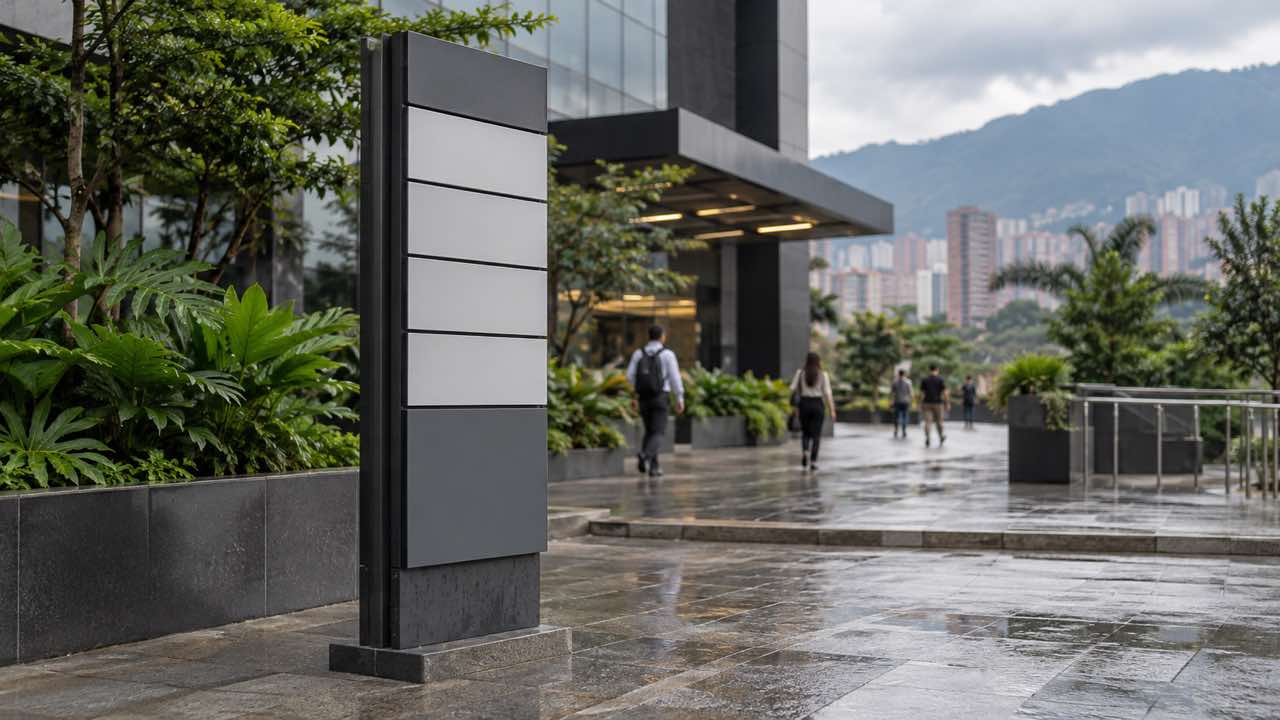
Static exterior directional totem at an urban complex entrance. Illustrative image generated with artificial intelligence.
The proposal retains, as a reference for a billboard, a maximum area of 48 m² and a minimum height of 2.50 meters between its lower edge and the ground. Those dimensions do not transfer automatically to every exterior totem. Their application depends on the piece’s classification and its specific location.
- Purpose: identifying an entrance, guiding visitors, or displaying changing messages.
- Orientation: a face visible from a road can change the content conditions.
- Lighting: energy efficiency and light control are criteria present in the proposal.
- Classification and location: these determine whether a billboard reference applies.
Agreement 026 of 2025 changed Medellín’s outdoor visual advertising rules and redefined the Special Regulatory Areas. A later proposal can guide a design without yet becoming a binding requirement. The final decision needs a quotation that describes the scope, location, and any procedure applicable to the case.